
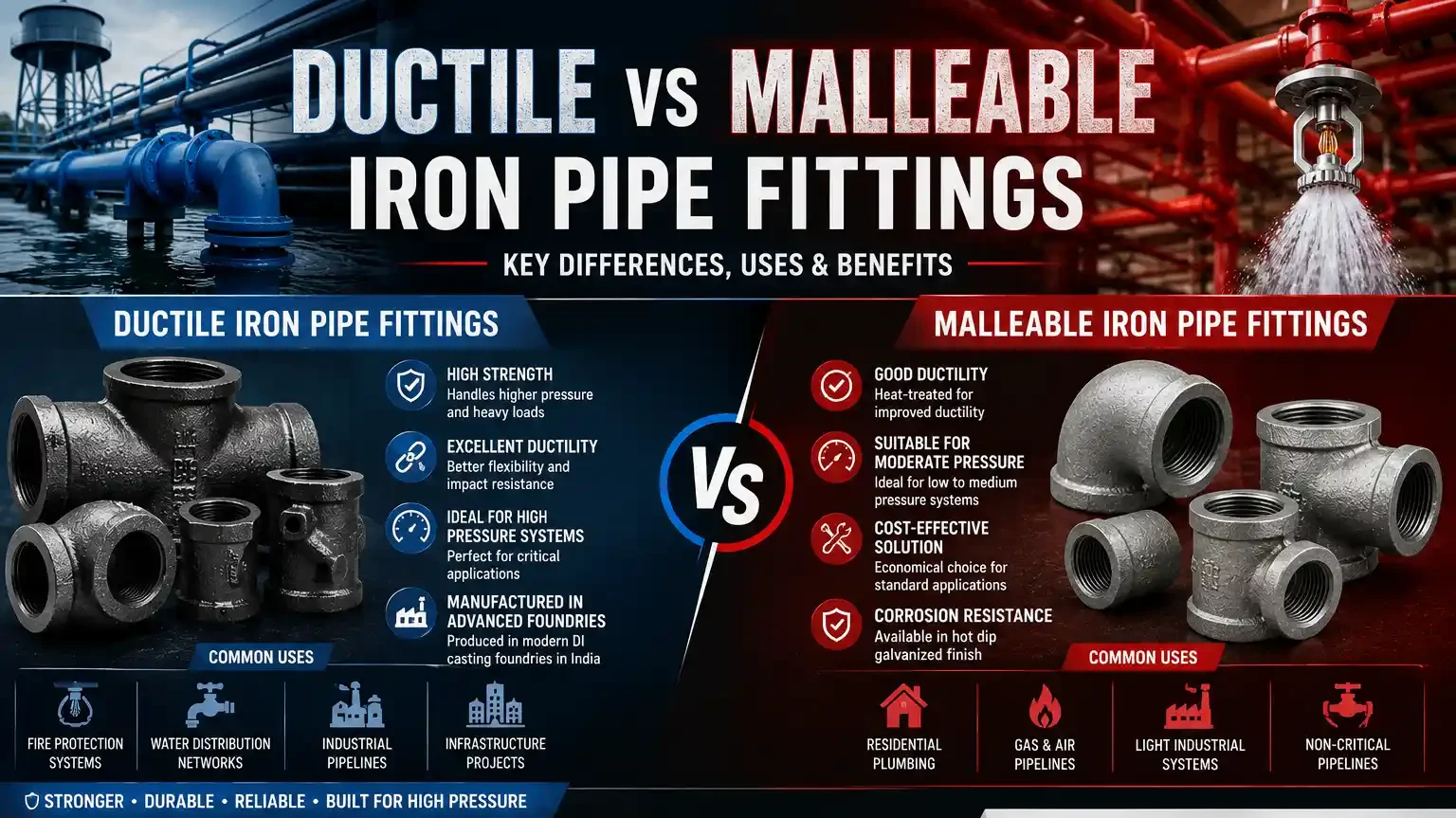
DI vs MI fittings comparison helps determine which pipe fitting material offers better strength, durability, and pressure handling for industrial and fire protection applications. Choosing the right fitting can improve system reliability and reduce maintenance costs over time.
Choosing the right pipe fittings is essential for ensuring strength, durability, and long-term performance in any piping system. One of the most common comparisons in the industry is ductile vs malleable iron pipe fittings. As a trusted DI pipe fittings manufacturer and industrial pipe fittings manufacturer India, understanding this difference helps engineers, contractors, and buyers make the right decision.
What Are Ductile Iron Pipe Fittings?
Ductile iron fittings in India are made from nodular cast iron, where graphite is present in spherical form. This structure gives them high strength, flexibility, and impact resistance. It was invented in 1943 as Casting material having properties similar to wild steel.
Manufactured in advanced ductile iron casting foundry India, these fittings are widely used in Industrial and infrastructure pipelines .
- DI fittings for water distribution
- DI fittings for fire systems
They are ideal for high-pressure applications and are commonly used in fire protection pipe fittings and high-pressure threaded fittings.
What Are Malleable Iron Pipe Fittings?
Malleable iron 300 years old casting technology, but now has been replaced majority by ductile Iron . Malleable iron pipe fittings are produced by heat-treating white cast iron to improve ductility. Many MI fittings manufacturer India produce these fittings for various applications, but after invention and adaption of ductile iron almost 90% of Indian foundries have converted to ductile Iron.
They are commonly used in:
- Plumbing systems
- Gas and air pipelines
- Low to medium pressure systems
Many products are also available as hot dip galvanised fittings, supplied by a galvanized pipe fittings manufacturer for better corrosion resistance.
When conducting a DI vs MI fittings comparison, it is important to evaluate factors such as strength, pressure handling, durability, and application suitability.
Ductile vs Malleable Fittings: Key Differences
1. Strength & Pressure Handling
Ductile iron fittings are stronger and can handle higher pressure. They are often used by 500 PSI
pipe fittings manufacturer companies for demanding environments.
Malleable fittings are suitable for moderate pressure and lighter applications.
2. Flexibility & Durability
Ductile iron offers excellent flexibility and impact resistance, making it ideal for heavy-duty
systems.
Malleable iron is durable but less flexible compared to ductile iron.
3. Applications
Ductile iron fittings India are used in:
Fire safety systems (fire sprinkler fittings India)
Water supply networks
Industrial pipelines
Malleable iron pipe fittings are used in:
Residential plumbing
Light industrial systems
Non-critical pipelines
4. Manufacturing Process
Ductile iron fittings are produced in modern Indian foundry for DI castings, ensuring high
strength and minimal defects.
Malleable fittings are manufactured through a heat treatment process that improves their ductility and usability.
5. Corrosion Resistance
Both fittings can be protected using the hot dip galvanizing process offering long-lasting
performance in harsh environments.
Based on this DI vs MI fittings comparison, ductile iron fittings are generally preferred for critical and high-pressure applications.
Which One Should You Choose?
- Choose ductile iron fittings for high-pressure, fire protection, and infrastructure projects
as they offer better mechanical properties and higher strength than malleable iron fittings. - Choose malleable iron pipe fittings for low to medium pressure and cost-effective
solutions.
For critical systems, ductile iron is always preferred by pipe fittings for the MEP contractors
and consultants. The amount spent on DI fittings is worth it due to their durability, longer service life.
Conclusion
In the DI vs MI fittings comparison, both materials serve different purposes. However, ductile iron fittings stand out for their strength, durability, and ability to handle high pressure. If you are working on fire protection or industrial systems, choosing ductile iron from a trusted threaded fittings manufacturer or grooved pipe fittings India supplier ensures long-term safety and performance. Jainsons Malleables is known for delivering high-quality products as a pipe fittings supplier India and heavy-duty fittings manufacturer.
This DI vs MI fittings comparison shows that both materials have their advantages, but ductile iron remains the preferred choice for demanding industrial and fire protection systems.
FAQ (Frequently Asked Questions)
1. What is the difference between ductile and malleable iron fittings?
Ductile iron fittings are stronger and used for high-pressure systems, while malleable iron fittings are suitable for low to medium pressure applications.
2. Which fittings are better for fire protection systems?
Ductile iron fittings are preferred for fire protection systems due to their high strength and essure resistance.
3. Are malleable iron fittings durable?
Yes, malleable iron fittings are durable for standard applications but not ideal for high-pressure
environments.
4. What is the use of ductile iron fittings?
They are used in water distribution, fire protection, and industrial pipelines where high strength is required.
5. Do both fittings support galvanization?
Yes, both can be coated using the hot dip galvanizing process for better corrosion resistance.